|
Peter L. Hurd, Professor. Department of Psychology, & Neuroscience and Mental Health Institute University of Alberta Edmonton, Alberta, Canada T6G 2E9 Ph (office) : 780.492-3578 Ph (dry lab) : 780.492-5259 Ph (wet lab) : 780.492-8058 Fax (dept): 780.492-1768 e-mail: phurd@ualberta.ca Office: Biological Sciences Building, Room P-449 Office Hours: 11:00 - 12:00 Weds and Fri |

|
Peter L. Hurd @ ResearchGate, ResearcherID, GoogleScholar
Research and Supervision in the Hurd Lab:
Lab members conduct research in the broad areas of neuroscience, behavioural ecology, genetics and personality in both human and non-human animals. Personality-like traits that we are particularly interested in include aggressiveness and stress coping style. We are interested in how the developmental process of sexual differentiation produces personalities, brains, and bodies on a non-binary male-to-female spectrum, and how exposure to stressors early in life shapes adult personality and physiology.
Using both humans and cichlid fish as research subjects, members of my lab investigate the links between environmental influences, genes, hormones, brain and behaviour. My work has examined how individual variation in social behaviour:
- evolves — through the use of game theoretical models,
- is tied to genetic variation — through the use of molecular genetics,
- is tied to brain structure and function — using a variety of neuroscience techniques, and
- is influenced during development by environmental factors.
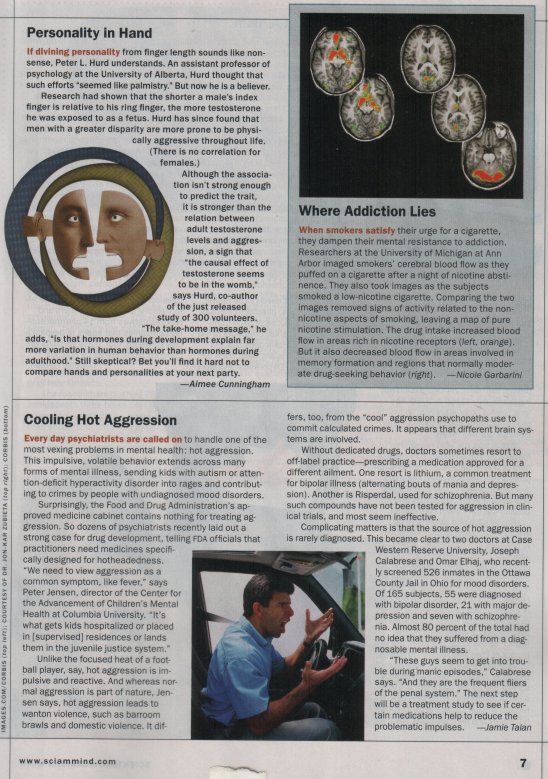
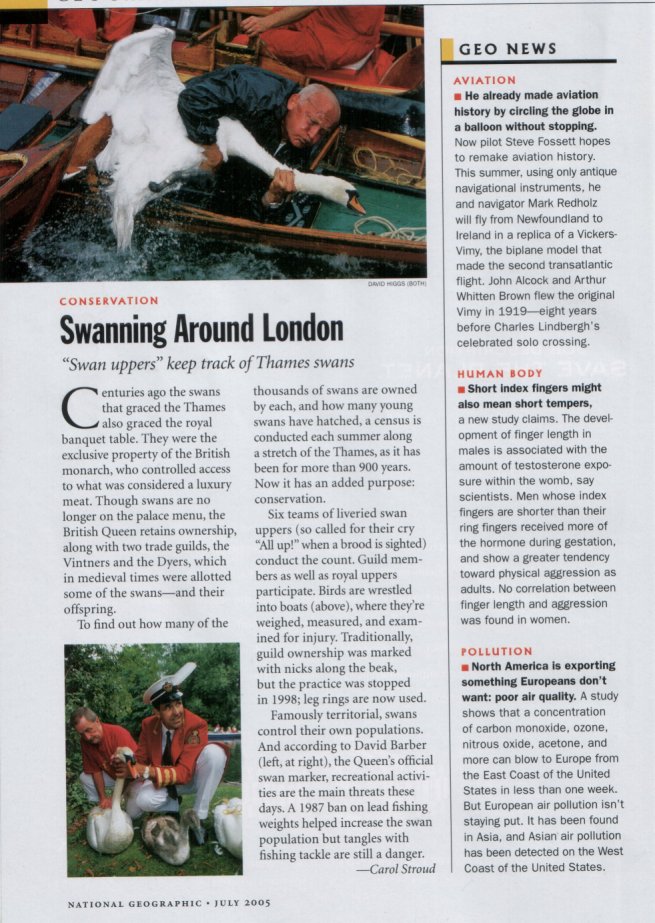
A write-up of some of my more recent-ish research can be found in this departmental researcher highlight, glib biographical academic profile, and an amusing older Prof of the Month interview. Some of my older research is profiled in this University press release, and coverage of some of my grad student, Allie Bailey's, work. More coverage by of the same work by the BBC, the New York Times, Discover Magazine, Scientific American Mind, National Geographic and Jay Leno.
Student Opportunities: Openings for Graduate and Undergraduate students, and funded Postdocs, exist in the lab (click for more information).
Teaching and Advising:
A list of courses I have taught, some words about my teaching philosophy etc. are on my Teaching Page, a collection of gathered wisdom for students on the general topic of learning and scholarship can be found on my Page of Assorted Cruft.
Recent Work:
- Bartlett NT, Morin JR, Hurd PL. in press. Does the fraternal birth order effect influence handedness? to appear in Archives of Sexual Behavior (doi:10.1007/s10508-023-02649-9).
- Chaput S-L, Burggren WW, Hurd PL, Hamilton. 2023. Zebrafish (Danio rerio) shoaling in light and dark conditions involves a complex interplay between vision and lateral line. Behavioural Brain Research 439:114228. (doi:10.1016/j.bbr.2022.114228).
- Yang N, Hurd PL, Read S, Crespi BJ. 2022. Why iPlay: The relationships of autistic and schizotypal traits with patterns of video game use. Frontiers in Psychology 13:767446. (doi:10.3389/fpsyg.2022.767446).
- Renn SCP, Hurd PL. 2021. Epigenetic regulation and environmental sex determination in cichlid fishes. Sexual Development 15:93-107. (doi.org/10.1159/000517197).
- Manning C, Hurd PL, Read S, Crespi BJ. 2021. SHANK3 genotype mediates speech and language phenotypes in a non-clinical population. Autism Research and Treatment 2021:6634584. (doi:10.1155/2021/6634584).
- Nahal P, Hurd PL, Read S, Crespi BJ. 2021. Cognitive empathy as imagination: evidence from Reading the Mind in the Eyes in autism and schizotypy. Frontiers in Psychiatry 12:665721. (doi:10.3389/fpsyt.2021.665721).
- Robles D, Kuziek JWP, Wlasitz NA, Bartlett NT, Hurd PL, Mathewson KE. 2021. EEG in motion: Using an oddball task to explore motor interference in active skateboarding. European Journal of Neuroscience. (doi:10.1111/ejn.15163).
- Driscoll RMH, Faber-Hammond JJ, O’Rourke CF, Hurd PL, Renn SCP. 2020. Epigenetic regulation of gonadal and brain aromatase expression in a cichlid fish with environmental sex determination. General and Comparative Endocrinology 296:113538. (doi.org/10.1016/j.ygcen.2020.113538).
- Salminen I, Read S, Hurd PL, Crespi BJ. 2020. Does SNORD116 mediate aspects of psychosis in Prader-Willi syndrome? Evidence from a non-clinical population. Psychiatry Research. 286:112858. (doi:10.1016/j.psychres.2020.112858).
- Hope BV, Fjellner KL, Renn SCP, Hurd PL. 2020. Juvenile stress disrupts the development of an exploration-boldness behavioural syndrome in convict cichlid fish. Animal Behaviour. 161:95-102. (doi:10.1016/j.anbehav.2020.01.004).
- Crespi BJ, Read S, Ly A, Hurd PL. 2019. AMBRA1, autophagy, and the extreme male brain theory of autism. Autism Research and Treatment 2019:1968580 (doi:10.1155/2019/1968580).
- Hope BVH, Hamilton TJ, Hurd PL. 2019. The submerged plus maze as an assay for studying anxiety-like behaviour in fish. MethodsX (doi:10.1016/j.mex.2019.07.002).
- Salminen I, Read S, Hurd PL, Crespi, BJ. 2019. Genetic variation of UBE3A is associated with schizotypy in a population of typical individuals. Psychiatry Research 275:94-99. (doi:10.1016/j.psychres.2019.03.019).
- Crespi BJ, Dinsdale NL, Read S, Hurd PL. 2019. Spirituality, dimensional autism, and schizotypal traits: The search for meaning. PLoS ONE 14(3): e0213456. (doi:10.1371/journal.pone.0213456).
- Hope BVH, Hamilton TJ, Hurd PL. 2019. Submerged plus maze: A novel test for studying anxiety-like behaviour in fish. Behavioural Brain Research 362:332--337. (doi:10.1016/j.bbr.2018.12.012).
- Long RM, Pakan JMP, Graham DJ, Hurd PL, Gutiérrez-Ibáñez C, Wylie DR. 2018. Modulation of complex spike activity differs between zebrin positive and negative Purkinje cells in the pigeon cerebellum. Journal of Neurophysiology 120:250–262. (doi:10.1152/jn.00797.2017).
- Jha A, Read S, Hurd PL, Crespi BJ. 2018. Segregating polymorphism in the NMDA receptor gene GRIN2A, schizotypy, and mental rotation among healthy individuals. Neuropsychologia 117:347–351.(doi:10.1016/j.neuropsychologia.2018.06.021).
- Craciun I, Gutiérrez-Ibáñez C, Corfield JR, Hurd PL, Wylie DR. 2018. Topographic organization of inferior olive projections to the zebrin II stripes in the pigeon cerebellar uvula. Frontiers in Neuroscience 12:18 (doi:10.3389/fnana.2018.00018).
- Crespi BJ, Read S, Salminen I, Hurd PL. 2018. A genetic locus for paranoia. Biology Letters 14:20170694 (doi:10.1098/rsbl.2017.0694).
- Bartlett NT, Hurd PL. 2018. Fraternal birth order effects on personality: Will reasonable claims require extraordinary evidence? Archives of Sexual Behavior 47: 21-25. (doi:10.1007/s10508-017-1109-z).
- Crespi BJ, Read S, Hurd PL. 2018. The SETDB2 locus: evidence for a genetic link between handedness and atopic disease. Heredity 120:77–82. (doi:10.1038/s41437-017-0004-7).